- calendar_today August 14, 2025
.
Fresh doubts about the future of electric vehicles (EVs) in the U.S. are emerging as sales decelerate and the country’s charging network continues to face infrastructure and adoption hurdles. After more than a year of month-over-month gains, EV sales have started to decline. Genesis and Volvo are among the brands that have seen EV buyers back away, prompting the two automakers to reconsider their lineups.
The new administration in Washington, DC, has also dialed back on subsidies and rescinded vehicle pollution rules, reducing federal incentives. But industry analysts say that the biggest deterrent to EV adoption in the U.S. is closer to home.
Charging by the Garage Door
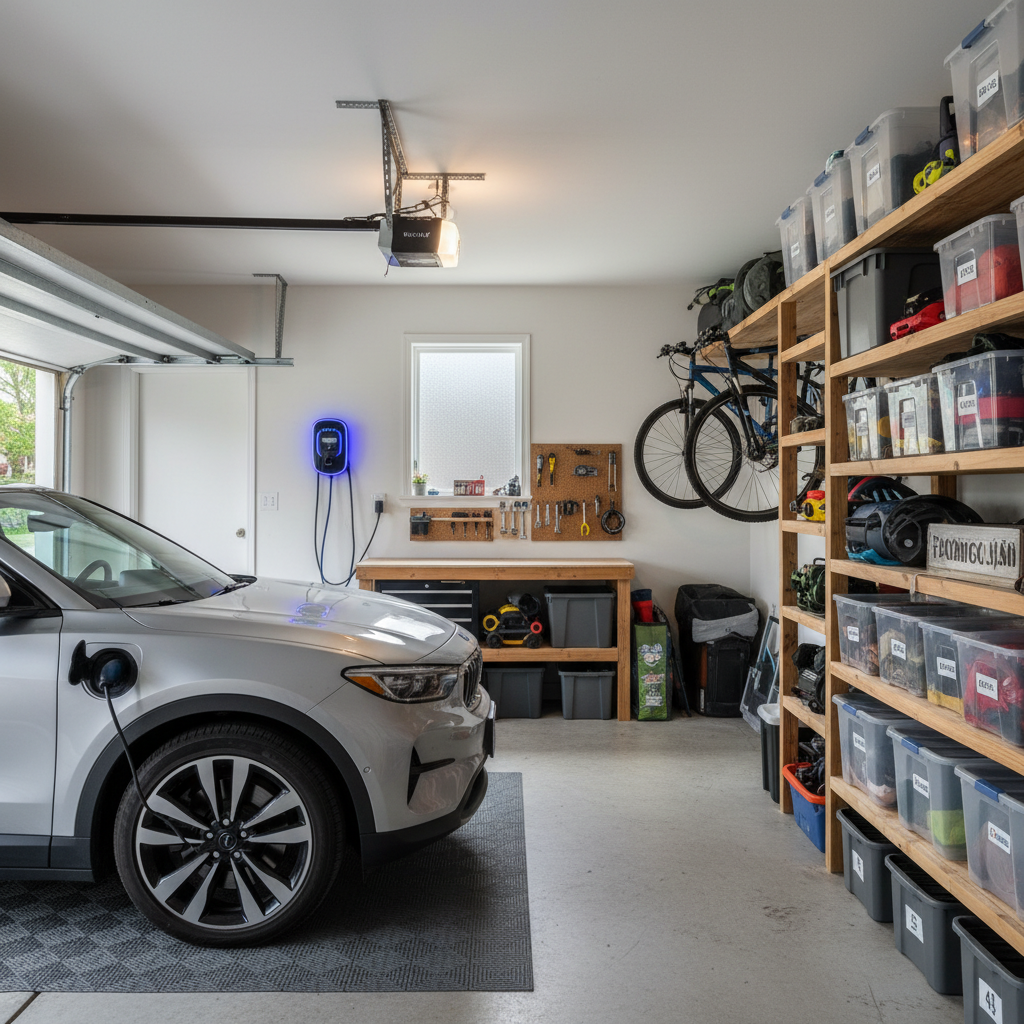
For a long time, surveys have indicated that anxiety over charging is the largest barrier to electric adoption. Now, Telemetry Vice President Sam Abuelsamid takes a deeper look in a new market research report into the phenomenon, focusing on a long-neglected issue: how people use their garages.
Fast chargers have received a lot of attention, but most EV charging is at home. An estimated 80 percent of all EV charging takes place using AC power, with a single-family residence the most popular spot to plug in. According to data from the National Renewable Energy Laboratory (NREL), 42 percent of homeowners are already parking close to an outlet that can power level 2 (240 volt) charging.
If homeowners opened up space in their garages and altered their parking behavior, that figure could rise sharply, to 68 percent. Abuelsamid said “90 percent of all houses can add a 240 V outlet near where cars could be parked. Parking behavior, namely whether homeowners use a private garage for parking or storage, will likely become a key factor in EV adoption.”
Opening up parking space in garages for vehicles instead of storage could more than double the number of homes with EV charging capability, from 31 million to more than 50 million. Factoring in homes where new wiring is possible, that number could top 72 million. That total is higher than even Telemetry’s most bullish estimate for EV penetration in 2035, which is 33 million to 57 million vehicles.
Cost Is a Barrier
Paper charging capacity does not equate to real-world readiness. The NREL study also found that nearly 34 million homes would need expensive electrical upgrades to power a level 2 charger, which requires at least 30 amps. These improvements, which can range from new wiring to whole panel replacements, could cost homeowners thousands of dollars.
This directly contradicts a key selling point of EVs: their lower cost over the long term. When installation costs for charging infrastructure are added to the purchase price, the total cost of ownership can quickly match or even surpass that of an internal combustion vehicle.
Multifamily Housing Problems
The situation is even worse for the 23 percent of Americans who reside in multifamily units like apartments, condos, and townhomes. Unlike with single-family homes, individual EV owners in these buildings rarely have the power to install chargers, let alone access financing. Instead, they must persuade landlords, management companies, or co-op boards to go along with the idea—an outcome that is far from certain.
The financial barrier is also greater. Putting in a pair of shared level 2 chargers at a co-op building, for instance, may first require a whole electrical panel upgrade, which could set the building back millions. Wiring may need to be run to distant parking spots, which also adds cost. In many of these situations, residents are often not eligible for municipal or utility subsidies for chargers.
Currently, there are about a million EV owners in multifamily housing, but only 11 percent park within range of an outlet they could use to charge. In some states, new construction is required to have 20–25 percent of parking spaces reserved for EVs, but even with those mandates, Telemetry estimates there will only be 6.7 million to 11.4 million charging-capable spaces in multifamily dwellings in 2035. That’s still not enough to meet projected demand.
The Public Charging Shortfall
The limits of home charging mean public infrastructure will be critical. Telemetry projects that 11.7 million to 14.3 million EV drivers who own a house will need to use public charging in 2035. Another 7.8 million to 8.1 million EV owners who live in multifamily housing will also require access to public chargers.
To satisfy that demand, 523,000 to 586,000 DC fast chargers will be needed, as will an additional 1.5 million to 1.6 million level 2 chargers across the country. But building that infrastructure is not without its challenges. Electricity companies are already straining to keep up with the voracious appetite of new AI data centers for both generation and transmission capacity, making the rollout of large-scale charging sites more difficult.
One Thing Is for Sure
All the recent enthusiasm for EVs masks a more complicated reality on the ground in the U.S. Thousands of homes across the country could have the capacity to support EV charging, but garage clutter, the high cost of electrical upgrades, and the difficulties of multifamily living could all put the brakes on adoption. Even if public charging is greatly expanded, demand could outstrip supply during the next decade.
One thing, however, is certain: the future of EVs in America will be determined as much by the way homeowners use their garages as by government policy or automaker plans.