- calendar_today August 8, 2025
.
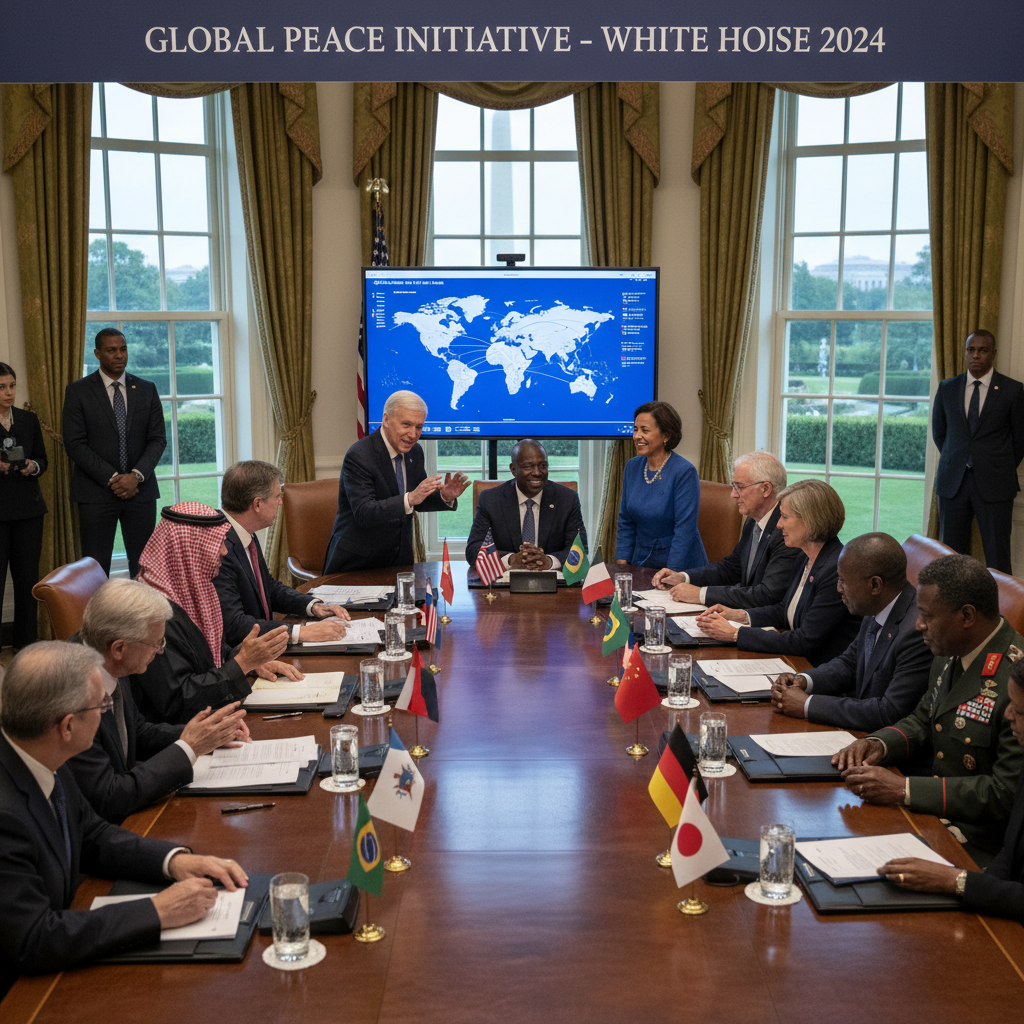
President Donald Trump is once again laying claim to the mantle of a dealmaker on the global stage, this time saying he has already ended six wars during his second term in office. The claim came on Monday at a meeting at the White House with Ukrainian President Volodymyr Zelensky and a group of European leaders, during which he also suggested he was on the way to ending the long-running and ruinous war in Ukraine.
“I’ve done six wars — I’ve ended six wars,” Trump said during the meeting, going on to say that his interventions were in the Middle East, Africa and parts of Asia. “Look, India-Pakistan, we’re talking about big places. You just take a look at some of these wars. You go to Africa and take a look at them.”
The White House this month released a statement branding Trump the “President of Peace” for a series of agreements or diplomatic gestures between Armenia and Azerbaijan, Cambodia and Thailand, Israel and Iran, Rwanda and the Democratic Republic of the Congo, Egypt and Ethiopia, and Serbia and Kosovo. In addition, it noted the Abraham Accords, which were signed late in Trump’s first term and established normalized ties between Israel and a host of Arab states.
In many ways, the marketing is as important to Trump as the diplomacy. Critics say the victories are overstated or illusory, but his team is clearly trying to build a record that will support the long-running Trump campaign for the Nobel Peace Prize.
Longer-Term Solutions Elusive in Trump Peace Deals
Foreign policy analysts say that Trump’s victories have often not been permanent solutions to deep-seated problems. In some cases, the agreements appear more like temporary ceasefires than durable peace treaties. The most dramatic example is that of Israel and Iran. In the aftermath of a short, sharp 12-day war, Trump said he had brought about peace. But the truce is not formal and hostilities over Tehran’s nuclear program simmer.
Trump has also suffered some reversals. He has promoted peace between Israel and the Hamas movement in Gaza, but that effort fell apart after a bout of violence. His heavily publicized diplomacy with North Korean leader Kim Jong Un in his first term yielded a number of photo ops, but has not seen a slowing of Pyongyang’s nuclear weapons program.
One of Trump’s most recent foreign policy initiatives was an agreement between Armenia and Azerbaijan declaring peace between them. The deal, brokered at the White House earlier this month, requires the two countries to recognize borders and renounce the use of violence. It also announced a U.S.-backed transportation corridor that has been dubbed the “Trump Route for Peace and Prosperity.”
Azerbaijani President Ilham Aliyev called the agreement a “miracle” and gave the credit to Trump. “President Trump, in six months, did a miracle,” Aliyev said.
But analysts are urging caution and point to the fact that many of the constitutional and territorial disputes between the two countries are unresolved, and could renew the conflict at any moment.
‘Pressure Diplomacy’ in Southeast Asia and South Asia
In Southeast Asia, Trump said he had threatened to pull trade deals with Cambodia and Thailand unless they ended a border war that left at least 38 people dead. His crude leverage, combined with ASEAN’s pressure, led to the two sides halting their violence. The Cambodian Prime Minister Hun Manet even nominated Trump for the Nobel Prize for what he called “extraordinary statesmanship.”
In a similar vein, Trump had stepped in to defuse a border dispute between India and Pakistan in May. That region has seen three wars over the disputed Kashmir region. In that case, Pakistan’s foreign minister was effusive in his praise of Washington’s role, while India denied U.S. mediation. The agreement is tenuous and the underlying territorial dispute is far from resolved.
Fragile Ceasefire in Africa
Trump has also pointed to a deal struck between Rwanda and the Democratic Republic of the Congo to recognize borders and disarm militia groups in the area. But the M23 rebel movement that has been at the heart of the conflict there has rejected the deal, and many of the agreements between Rwanda and DRC are seen as a way for the United States to compete with China for access to African minerals.
The president also alluded to Egypt and Ethiopia, which have been in a long-running dispute over a huge dam project on the Nile. Trump has spoken to both leaders and pressed them to compromise, but no formal agreement has been struck.
The White House has also touted Trump’s earlier efforts to encourage economic normalization between Serbia and Kosovo. The two have had a long-running diplomatic dispute, but little has been achieved on the ground in the months since the Trump agreement, and much of the progress is directed by the European Union.
Trump’s declaration that he is ending wars underscores his unconventional diplomatic style and his tendency to overstate the results. Critics say that the scaling back of the State Department and U.S. Agency for International Development undercuts Trump’s ability to turn ceasefires into lasting peace.
But even skeptics give the president credit for the fact that, on occasion, his heavy-handed interventions have produced results. “The ones that were helpful, especially India-Pakistan, were conducted in a professional way, quietly, diplomatically … laying the ground and finding common ground between the parties,” said Celeste Wallander, who worked at the Pentagon under President Barack Obama and is now with the Center for a New American Security.
Whether Trump’s most recent efforts, particularly on Ukraine, will turn out to be lasting is not yet clear. His track record so far is mixed: bold interventions, aggressive branding, and some unfinished business.